
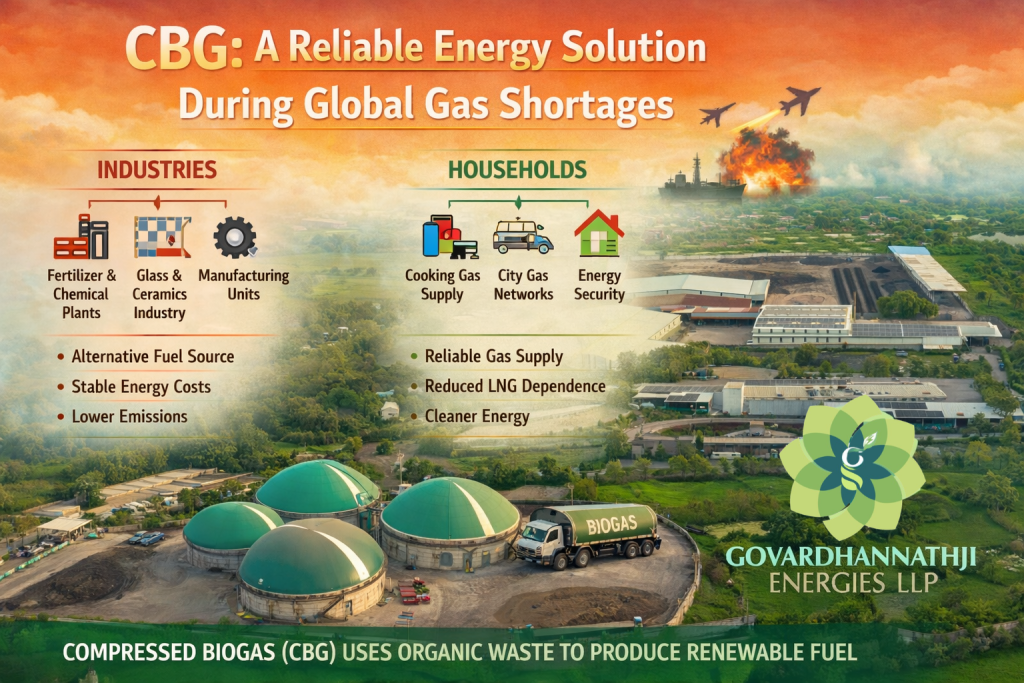
In today’s interconnected world, geopolitical tensions can quickly affect global energy markets. A potential conflict involving United States and Iran could disrupt major oil and natural gas supply routes in the Middle East, causing price spikes and shortages in LNG-dependent countries like India.
Such global crises highlight the importance of domestic renewable energy solutions, and one of the most promising alternatives is Compressed Biogas (CBG). Companies such as Govardhannathji Energies LLP are contributing to building resilient energy infrastructure by converting organic waste into clean fuel and organic fertilizers.
This blog explores how CBG can support industries, surrounding businesses, and household gas supply during international gas shortages.
The Middle East remains a critical hub for global oil and gas transportation. Disruptions in this region can impact shipping routes and LNG supply chains worldwide.
Countries that depend heavily on imported natural gas may face:
In such situations, locally produced renewable gas like CBG can act as a strategic energy backup.
Compressed Biogas is a purified form of biogas produced through the anaerobic digestion of organic materials, including:
After purification and compression, the gas reaches methane purity similar to natural gas and can be used as a direct substitute for CNG and piped natural gas (PNG).
India has huge potential for producing CBG from biomass, and government initiatives like the SATAT scheme are promoting large-scale production of renewable gas to reduce dependence on fossil fuels.
Many industries rely on natural gas as a primary fuel source. When global supply chains are disrupted, production costs increase significantly.
Locally produced CBG can provide an alternative fuel supply, helping industries maintain operations even during international energy disruptions.
1. Energy Security
CBG is produced locally from organic waste, reducing dependence on imported LNG.
2. Price Stability
Domestic bioenergy sources protect industries from volatile international gas prices.
3. Infrastructure Compatibility
CBG can be used in existing gas pipelines, burners, and industrial equipment with minimal modification.
4. Sustainability Compliance
Using renewable gas helps industries meet ESG and environmental sustainability targets.
In times of global fuel shortages, governments prioritize household cooking gas supply. However, if imports are disrupted for extended periods, city gas distribution systems may face pressure.
CBG can be integrated into city gas networks, allowing renewable gas to supplement natural gas supply.
Benefits for households include:
As India expands renewable gas infrastructure, CBG can become a significant component of urban household gas supply systems.
India imports a large portion of its natural gas requirements. Expanding CBG production helps the country reduce this dependency.
Large-scale adoption of compressed biogas provides multiple benefits:
CBG production also aligns with India’s national clean energy goals and climate commitments.
Forward-looking companies like Govardhannathji Energies LLP are helping transform waste into valuable energy resources.
Through integrated waste-to-energy infrastructure, such companies contribute to:
By producing Compressed Biogas (CBG) and organic fertilizers, these initiatives simultaneously support energy security, agriculture sustainability, and environmental protection.
As global energy markets continue to face geopolitical uncertainty, countries are increasingly investing in decentralized renewable energy systems.
Compressed Biogas represents a powerful solution because it combines:
With the right infrastructure and industry participation, CBG could play a major role in powering industries, transportation systems, and household gas networks in India.
Global conflicts and supply disruptions can expose vulnerabilities in traditional energy systems. However, renewable fuels like Compressed Biogas (CBG) offer a reliable and sustainable alternative.
By expanding CBG production and integrating it into industrial and household gas supply systems, India can build a resilient, decentralized, and environmentally responsible energy future.
Companies such as Govardhannathji Energies LLP are already demonstrating how waste-to-energy technologies can strengthen energy security while supporting sustainable economic growt